
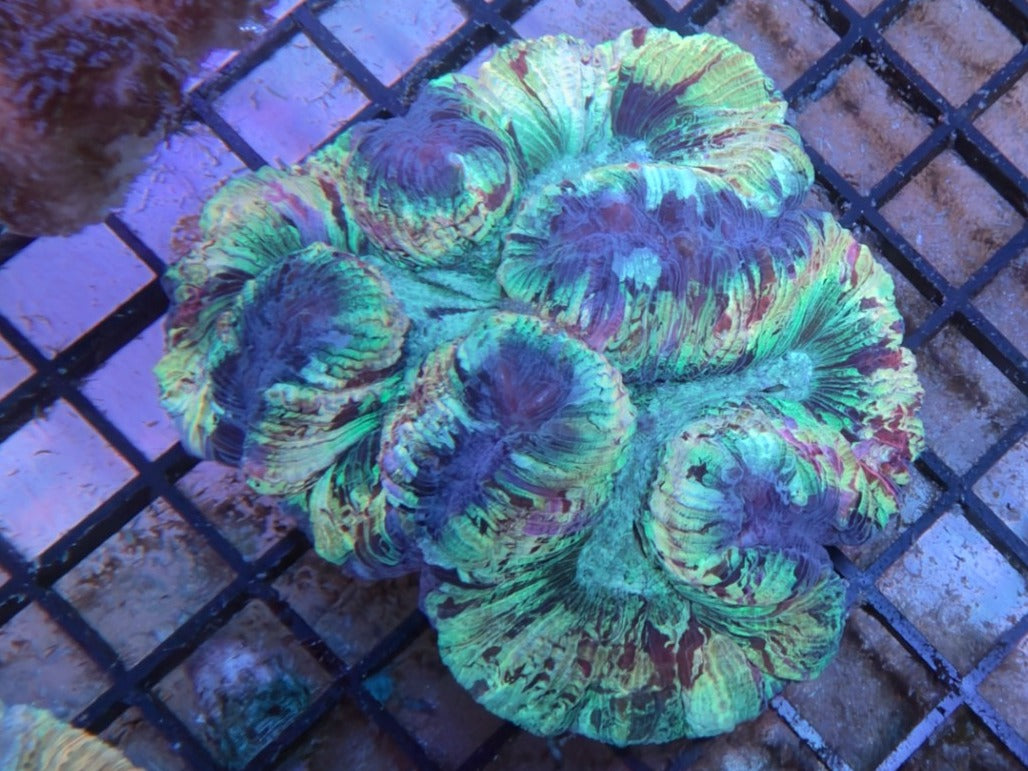
Open brain coral
Species guidance Revision 1AI-assisted · Model audited
Full care details
The open brain coral often lives unattached, with fleshy tissue over a solid skeleton. Fully extended tissue occupies more space than the exposed skeleton suggests.
- Acclimation
- Unknown · A supported value is unavailable for this group.
- Adult size
- Unknown · A supported value is unavailable for this group.
- Alkalinity
- Unknown · A supported value is unavailable for this group.
- Calcium
- Unknown · A supported value is unavailable for this group.
- Clearance
- Unknown · A supported value is unavailable for this group.
- Compatibility
- Unknown · A supported value is unavailable for this group.
- Care level
- Intermediate
- Feeding
- Photosynthetic; small meaty foods or appropriate coral pellets can be offered when tentacles are extended.
- Feeding frequency
- Unknown · A supported value is unavailable for this group.
- Water flow
- Gentle indirect circulation should keep the coral clean without flattening or abrading the polyp.
- Growth
- Unknown · A supported value is unavailable for this group.
- Habitat
- Unknown · A supported value is unavailable for this group.
- Handling
- Unknown · A supported value is unavailable for this group.
- Compatibility concerns
- Unknown · A supported value is unavailable for this group.
- Lifespan
- Unknown · A supported value is unavailable for this group.
- Lighting
- Low to moderate light is a conservative start; acclimate slowly and watch for paling.
- Magnesium
- Unknown · A supported value is unavailable for this group.
- Minimum tank size
- Unknown · A supported value is unavailable for this group.
- Nitrate
- Unknown · A supported value is unavailable for this group.
- PAR
- Unknown · A supported value is unavailable for this group.
- pH
- Unknown · A supported value is unavailable for this group.
- Phosphate
- Unknown · A supported value is unavailable for this group.
- Placement
- Open sandbed. Room for full inflation. Away from sharp rock and aggressive neighbors.
- Predation concerns
- Unknown · A supported value is unavailable for this group.
- Propagation
- Unknown · A supported value is unavailable for this group.
- Reef compatibility
- Unknown · A supported value is unavailable for this group.
- Salinity
- Unknown · A supported value is unavailable for this group.
- Social grouping
- Unknown · A supported value is unavailable for this group.
- Substrate
- Provide a stable, open area of substrate with room for the polyp to inflate.
- Temperament
- Allow room for expansion and competition
- Temperature
- Unknown · A supported value is unavailable for this group.
- Warning signs
- Tissue injury from rock or strong current. Bleaching after excessive light. Food theft and damage by fish, shrimp, or crabs.
- Warnings
- Unknown · A supported value is unavailable for this group.
Sources
- World Register of Marine Species — Trachyphyllia geoffroyi · Accepted marine species and synonym records · Retrieved 2026-11-10
- Tidal Gardens — Trachyphyllia open brain · Husbandry and scope notes, indexed by profile in the original editorial research · Retrieved 2026-11-07
- Corals of the World — Trachyphyllia geoffroyi · Species factsheet, Characters and Habitat · Retrieved 2026-11-10
- Tidal Gardens — Trachyphyllia Coral Care · Placement, Water Flow and Feeding · Retrieved 2026-11-10